Formula.life
Before you read a word — take a few breaths with me.
See yourself clearly.
For a mind that won’t switch off — racing after work, looping at night, louder the harder you try to stop it. Formula gives your attention a job to do instead, so the noise has nowhere to go.
Free. No sign-up.
See how it works ↓How it works
Most methods ask you to watch your thoughts. Formula.life does the opposite — it gives your mind a job.
You breathe, count, and sound a syllable all at once, and holding every channel of attention at once leaves no room for the noise. It takes a little effort, and that effort is the point: it crowds the thinking out.
That’s why it works on thought loops — the spirals you can’t think your way out of. You can’t talk yourself out of a loop, but you can breathe your way out. What actually breaks one, for me, is a full cycle — all forty-nine breaths. The short training here is only to learn the shape; do the whole forty-nine, and that’s when it truly works.
You can’t think your way out of a loop — the thought you use to stop it just becomes the next thought. So Formula doesn’t fight the loop. It gives your attention a different task, and the loop loses its grip.
Seven by seven
The whole practice is one shape: seven groups of seven breaths — forty-nine in all — with a single sound for each group. Every breath carries a few things at once.
Through the nose. Count the breath and picture the number as it comes — one, two, three — up to seven, the count and the image moving with the breath.
Carry the group’s syllable — under your breath, or only in your mind. You can picture the letters too. Sound and breath stay together.
One syllable per group, in sequence
Seven points of attention
- Breath1
- Count2
- Voice3
- Vision4
- Hear5
- Feel6
- Track7
and, above all seven, the witness who notices it all
The complete method holds all seven at once. The guided practice here begins with the first three — breath, count, sound — and the rest come with time.
The pace is a setting, not the method — here it’s a slow, even breath, about six seconds in and six out, and with practice you time it to your own body instead of the clock. Nothing is forced; the point is attention held on several things at once, not breathing hard.
Advanced: you can also borrow a principle from Buteyko — a short, quiet inhale, a longer exhale, and a light, comfortable air-hunger. As carbon dioxide rises a little, the body releases oxygen to the tissues more readily (the Bohr effect). Keep it light and unforced. Holding after the exhale can be powerful — but it’s an advanced technique to build up gradually, ideally with guidance, not something to push as a beginner. Never do breath control while driving or in water.
It’s a game, not a test. You will lose the count, and your attention will wander off — noticing that and coming back is the practice. When you lose your place, don’t restart from the beginning: trust your estimate and carry on. And if you start a cycle, finish the cycle.
That is the method — the whole of it. The guided training and the breathing circle on this page are only a way to learn it: the counting becomes yours, and then you need nothing but your own breath.
The quiet isn’t an empty mind. It’s no longer being pulled along by every thought that starts. You still think when thinking is useful — you’re simply not obliged to follow the noise.
This is my own lived experience, not medical advice. I’ve spent much of my life with relentless thought loops, and Formula.life is what reliably quiets them for me — with no medication. I can’t promise you the same; everyone is different. So don’t take my word for it: try it, and see how it feels for you.
The traditional pieces it draws on — counting, seed syllables, visual meditation — aren’t my invention. What’s mine is the particular structure, sequencing and synchronisation, and the way it’s framed for practical, everyday use. This is my own experience, not a medical claim.
The full method — and where it comes from — is in the courses.
Everything here is Feodor’s personal, lived experience — not medical advice, diagnosis, or treatment. Breathwork has contraindications: if you’re pregnant, epileptic, or have heart or blood-pressure conditions, talk to your doctor first.
Now — try it
First — how do you feel right now?
There’s no wrong answer. It just helps me point you the right way.
Where the silence is
The silence between thoughts
Thoughts move like a train — one carriage clamped to the next, with no gap between them. The quiet you’re looking for isn’t in stopping the train. It’s in the space between the carriages.
Formula widens that space. As you stretch the exhale and carry the count and the syllable, the gap between one breath and the next slowly opens — and in that gap, between a word and a breath, the silence is already there. Learning to rest in it is the first phase. For me it took years; the practice is how you shorten that.
What Formula really builds is attention itself. Train it long enough and a further step opens: resting at the still point in the centre of the head — what contemplative traditions call the position of the witness — where the quiet holds far longer. That deeper work is in the full course, and Formula is what makes it reachable at all: without trained attention it can take years to find; with it, far less.
In real life
Where Formula has helped me most
Not theory — the moments it actually got me through. My own stories, told honestly.
How I stopped being afraid of flying
For years I drove across Europe to avoid a plane. The breathing method that got me back in the air — one counted breath at a time.
Read the story →The dentist who couldn’t work out why I felt nothing
A breathing method you run in real time — in the chair, before a procedure — to stay calm and present when something hurts.
Read the story →The silence between thoughts
The quiet isn’t in stopping thought — it’s in the gap between thoughts. How breathing widens that gap, and what lies beyond it.
Read the story →Learning like a child again
Why does learning get harder with age? A theory: the mind fills with inner dialogue, leaving no room to take things in — and how breathing clears the space.
Read the story →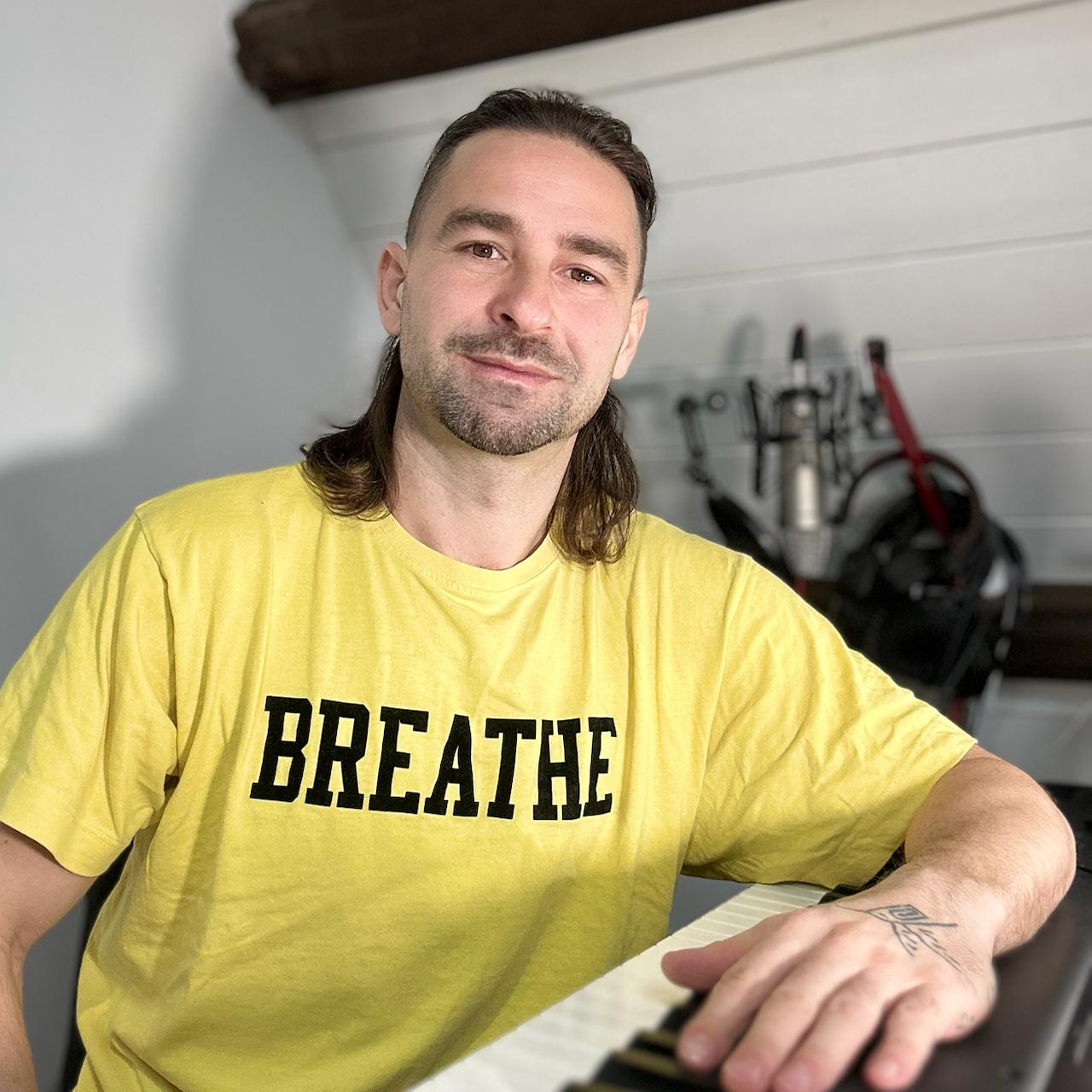
The person behind it
About Feodor
I am Feodor Kouznetsov (Фёдор Кузнецов) — founder of BreathLab in Brighton, a certified Buteyko Method instructor, and the creator of the Formula.life breathing method. My path into breathing didn’t start with wellness; it started with my own collapse — years of relentless thought loops, burnout and insomnia that no amount of thinking could fix. I’ve since spent more than 3,000 hours in conscious breathing practice, and built the Formula.life method out of what actually worked.
Certified Buteyko Method instructor · Founder, BreathLab Brighton · 3,000+ hours of practice
The Formula.life method and Buteyko: two tools, one breath
Buteyko gave me the physiology. Breathe lightly, let the exhale run longer, and allow a mild, comfortable air-hunger. As carbon dioxide rises a little, your blood releases oxygen to the tissues more readily — the Bohr effect — and the body settles at a chemical level, not by force.
The Formula.life method adds the attention. The seven-by-seven count and the syllable give a racing mind a job to do. Run the Formula.life method’s structure over Buteyko’s quieter breathing and you get both at once: the nervous system calming through the breath, and the mind with no room left for the loop.
Keep it light — mild air-hunger, never strain — and never practise breath control while driving or in water.
Work with Feodor
When the practice opens a door, this is how we walk through it together.
Support
Keep it free — and unlock the Advanced Formulas + Holdfire
Formula.life is free, and it stays free. If it has helped you, a small gift keeps it alive — and as a thank-you I’ll send you the six Advanced Formulas: for deep sleep, for paradoxical thinking, and four I’ve never written down anywhere else — plus Holdfire Part II, the advanced breath-hold programme.
Secure checkout via PayPal. Your gift arrives by email moments after.
Online consultation with Feodor
90 minutes · 1:1We look at what’s really driving it, and I show you how to work with your breath and the Formula for exactly what you’re dealing with — practised live, so you leave knowing what to do next.
- A clear breakdown of what’s actually behind your loop, burnout or sleeplessness
- Personal guidance on using the Formula in your situation
- We practise it live, so you feel it work before we finish
- A clear next step you can start the same day
Ninety minutes, one-to-one, directly with Feodor — not a team, not a script.
Go deeper — courses
Self-paced courses to take the method further, in your own time.
Most reviewedSilence — a meditation course for those with OCD, ADD & ADHD
Feodor’s most-reviewed course. Inner silence as a learnable skill, through breath — the most direct path to stillness.
View course →Perfect Balance — breathwork for ADHD & OCD
Tools for racing thoughts and compulsive loops — focus and nervous-system calm.
View course →Highest rated7 Habits of a Self-Loving Person
A 7-week breathwork journey into the habits behind your energy and resilience.
View course →You’re Breathing Wrong — And It’s Costing You
Eliminate mouth breathing and restore calm, clarity and control.
View course →Highest ratedToltec Dream Planting — for those who can’t lucid dream
Plant intentions before sleep and meet them in the dream state — Toltec + breath.
View course →Questions
What is Formula.life?
A conscious breathing method for a mind that won’t switch off. You breathe in seven groups of seven — forty-nine breaths — while counting and carrying a quiet syllable, so your attention has a job to do and racing thoughts have no room to run. It’s free to learn and practise.
Who is it for?
People whose minds won’t switch off — overthinkers, high performers, and many people with ADHD or an OCD-type mind who can’t stop the loops or the mental noise. Feodor built it living with his own ADHD and OCD, so it’s shaped for exactly that kind of mind. It isn’t a treatment and doesn’t replace care — if you’re doing therapy such as ERP for OCD, keep it, and let this sit alongside it.
How does it work?
Instead of fighting a thought, it gives your attention a structured task — breath, count, inner sound, body sense and keeping your place — all timed to the breath. Holding several of these at once leaves little capacity for a worry to build into a story. You can’t think your way out of a loop, so you change the task instead.
Is it the same as meditation?
No. Most meditation asks you to sit quietly and watch your thoughts. For a busy mind that open space often gets louder, not calmer. Formula does the opposite — it hands the mind an active, structured job. That’s why it often works for people who say they can’t meditate.
Is it free?
Yes. The practice is free to learn and do, and always will be. The paid options are live one-to-one sessions with Feodor, for people who want to go further.
Can it help with anxiety, ADHD or overthinking?
Many people with ADHD, an OCD-type mind, anxiety or relentless overthinking find it genuinely helps — Feodor created it living with his own ADHD and OCD. That’s lived and reported experience, not a medical claim: it’s a breathing and attention practice, not a treatment or cure. If you’re in treatment, keep it — this sits alongside care, it doesn’t replace it.
How long does it take, and do I need anything?
A few minutes. The full practice is forty-nine breaths, and you need nothing but yourself — you can learn it free here and eventually do it anywhere, with just your own breath.